Two Search Engines, One Strategy
Search has split into two lanes.
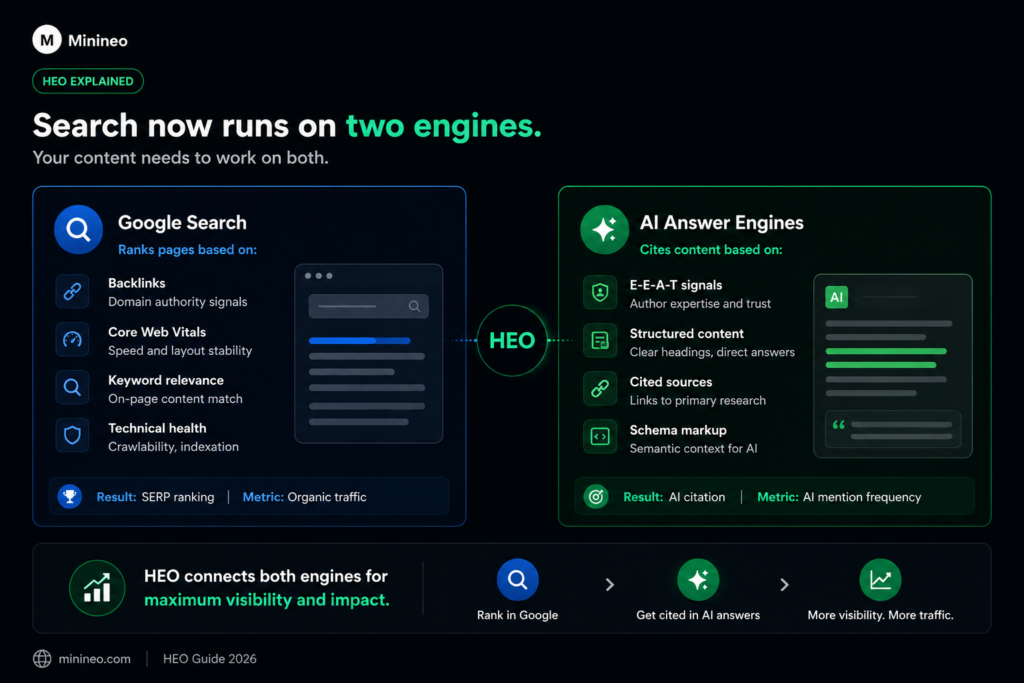
In one lane: Google’s traditional results, where rankings still depend on backlinks, technical health, and keyword relevance. In the other: AI-generated answers from ChatGPT Search, Perplexity, and Google’s AI Overviews, where your content either gets cited or gets skipped entirely regardless of where it ranks organically.
Most SEO advice still treats these as one problem. They are not. That gap is the problem Hybrid Engine Optimization (HEO) is designed to solve.
What Is Hybrid Engine Optimization?
Hybrid Engine Optimization (HEO) is a content and technical strategy that optimises for both traditional search engine results pages (SERPs) and AI-powered answer engines at the same time.
The word “hybrid” is deliberate. You do not abandon SEO. Domain authority, Core Web Vitals, and crawlability still matter. But you layer on a second set of optimisations aimed at how large language models read, evaluate, and cite content.
Traditional SEO asks: can Google crawl and rank this page?
HEO asks: can Google rank this page AND will an AI model trust it enough to cite it in an answer?
Those are related but meaningfully different questions.
Why HEO Matters in 2026
The numbers have shifted dramatically in the past 12 months.
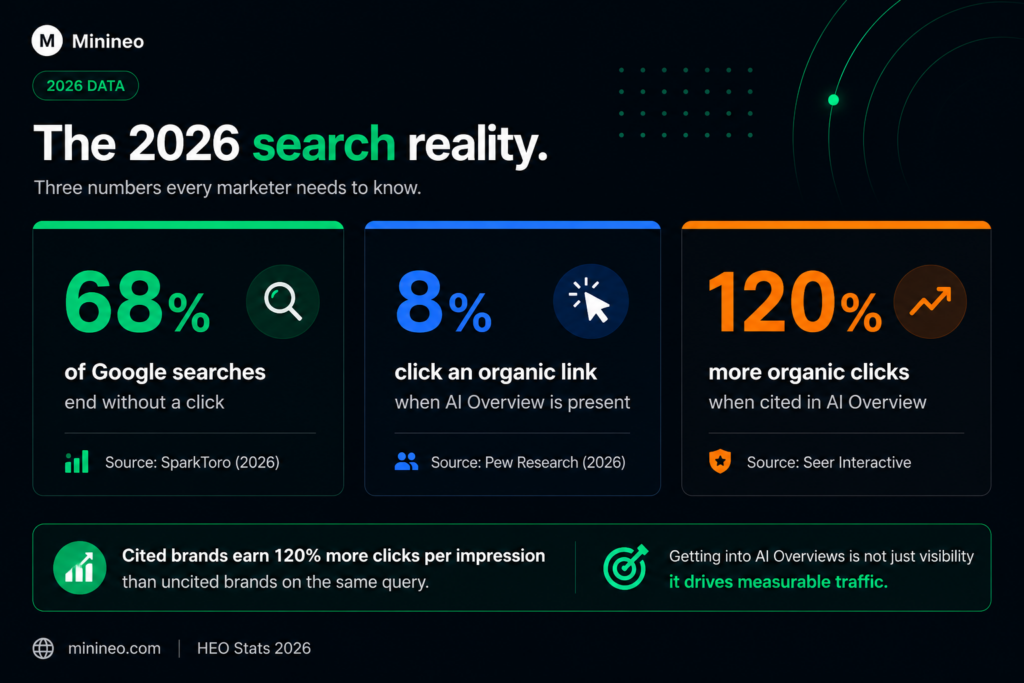
68% of Google searches in the US now end without a single click, according to SparkToro’s 2026 study based on Similarweb data. When Google AI Overviews are present, that effect compounds: a Pew Research field study of 68,000 queries conducted in early 2026 found users click an organic result just 8% of the time with an AI Overview present, compared to 15% without one.
AI Overviews now appear on roughly 48% of tracked search queries as of early 2026, up 58% year-over-year, and reach 2 billion monthly users across 200 countries. There is one counterintuitive finding worth noting: according to Seer Interactive’s analysis of 25 million impressions, brands cited inside an AI Overview earn approximately 120% more organic clicks per impression than uncited brands on the same query. Getting cited does not just increase brand awareness. It drives measurable traffic.
Outside of Google, ChatGPT crossed 1 billion monthly active users in June 2026 and processes over 2 billion prompts per day. Perplexity is handling an estimated 1.2 to 1.5 billion queries per month as of mid-2026, with 64% of its users being professionals doing work-related research.
The implication is straightforward. Organic rankings alone no longer guarantee visibility. A page that ranks on page one but never gets cited in AI Overviews or AI answer engines is reaching a shrinking fraction of its potential audience.
The Three Pillars of HEO
1. E-E-A-T: The Signal Both Engines Use
Google’s Quality Rater Guidelines have emphasised E-E-A-T (Experience, Expertise, Authoritativeness, Trustworthiness) for years. AI models have converged on similar evaluation logic. A study from Princeton and Georgia Tech, published at KDD 2024, found that content with strong authority signals and cited sources received 30 to 40% higher visibility in AI-generated responses compared to equivalent content without those signals.
In practice, E-E-A-T for HEO means:
- Named authors with real credentials in the byline
- First-hand observations grounded in actual use or testing, not paraphrased summaries
- Claims linked to primary research, not secondary roundups
- Visible publication dates and last-updated dates, since AI models weigh content recency
2. Content Structure AI Can Extract
AI models scan for extractable units: a definition, a statistic, a step-by-step process. Content that buries its key points inside long paragraphs gets skipped in favour of something cleaner.
Effective HEO structure:
- Answer the primary question within the first 100 words
- Use descriptive H2 and H3 headings that say exactly what the section contains
- Keep paragraphs to 2 to 4 sentences with one idea each
- Use numbered lists for any sequential process
- Include an FAQ section with direct, self-contained answers
Tools like Minineo’s AI Overview Optimizer audit your existing pages against these patterns before you publish.
3. Technical Signals: Schema, LLMs.txt, and Crawlability
Schema markup helps both Google and AI models understand what a page is, not just what it says. An Article schema with author, datePublished, and publisher fields signals credibility. FAQPage schema surfaces your Q&A directly in results. Google’s structured data documentation lists every supported type.
LLMs.txt was proposed in September 2024 by Jeremy Howard of Answer.AI. It is a plain-text Markdown file at /llms.txt that tells AI crawlers what your site covers and which pages matter most. Perplexity, Cursor, and several other AI tools now actively fetch it. As of mid-2025, over 15,000 domains had published an LLMs.txt file, with adoption accelerating. You can generate yours in under five minutes.
AI crawlers and robots.txt is a frequently overlooked issue. GPTBot, ClaudeBot, and PerplexityBot each have their own user-agent strings and are blocked by default on many sites. Check your AI crawlers list to confirm you are not blocking the tools you want citing your content.
HEO vs SEO vs GEO
| SEO | GEO | HEO | |
| Target | Google SERP rankings | AI citation visibility | Both simultaneously |
| Primary signal | Backlinks and technical health | E-E-A-T, structure, citations | All of the above |
| Content format | Keyword-optimised pages | Authoritative, citable content | Structured, verifiable, crawlable |
| Key metric | Organic traffic | AI citation frequency | Traffic and AI mentions |
GEO (Generative Engine Optimization) focuses purely on AI citation. HEO treats GEO and SEO as a unified strategy rather than separate tracks, because the content signals that earn AI citations overlap heavily with the signals that improve Google rankings. Optimising for one reinforces the other.
HEO Implementation Checklist
Content
- Primary question answered in the opening paragraph
- Named author with relevant credentials in the byline
- All statistics linked to primary sources, not other blogs
- At least one FAQ section with direct, self-contained answers
- Publication date and last-updated date visible on the page
Technical
- Article schema with author and publisher fields
- FAQPage schema on any FAQ section
- LLMs.txt published and current
- AI crawlers not blocked in robots.txt
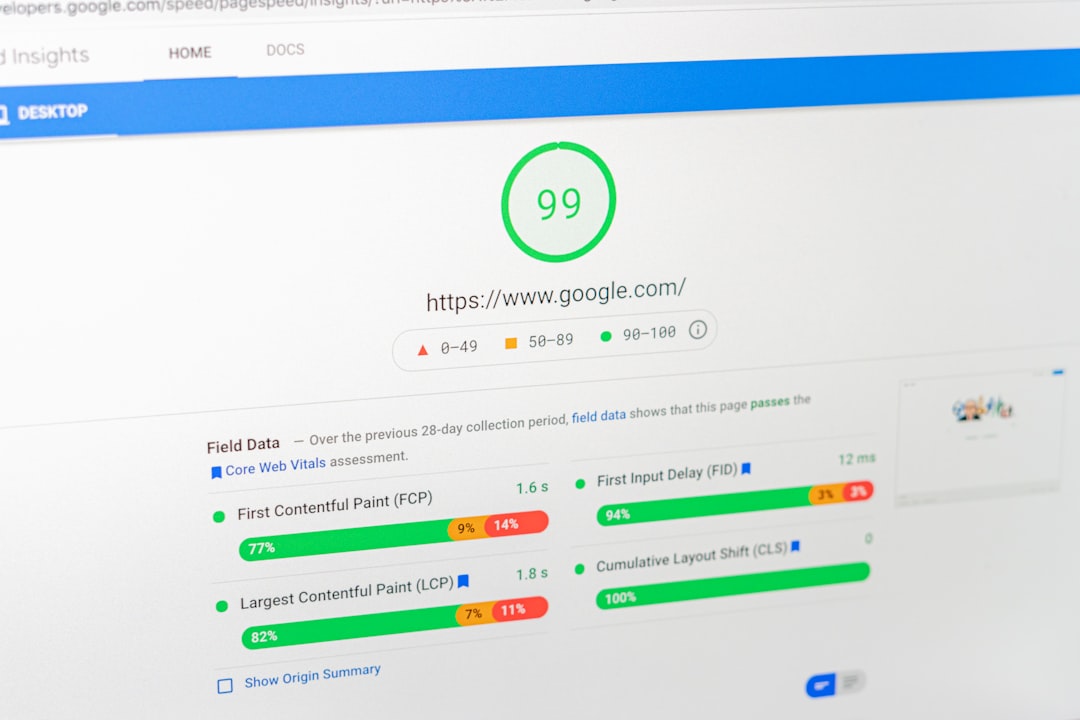
- Page loads in under 2.5 seconds (Core Web Vitals LCP)
GEO-specific
- Key definitions written as standalone sentences
- Comparison tables for any “X vs Y” topics
- Page included in LLMs.txt under the appropriate section
Run a full audit using Minineo’s Website Audit and Answer Engine Readiness Checker.
Common HEO Mistakes
Ignoring page speed while chasing AI citations. AI Overviews still pull from indexed pages. A slow page that does not rank cannot be cited.
Burying definitions. AI models look for explicit definitional sentences in the form “X is Y”. A definition woven into narrative prose is much harder to extract than a clean standalone sentence.
Blocking AI crawlers. Many site owners have blocked GPTBot, ClaudeBot, and PerplexityBot without realising it. Check your robots.txt before anything else.
Linking to secondary sources. A link to a blog that summarises a study carries less authority than a direct link to the study. Go primary where possible.
Treating HEO as a one-time fix. Google’s AI Overviews changed their triggering behaviour multiple times between 2024 and 2026. This is an ongoing practice, not a checklist you complete once.
Frequently Asked Questions
Hybrid Engine Optimization is a strategy that combines traditional SEO with specific optimisations for AI-powered search engines and large language models. It ensures content ranks well in Google’s standard results while also being cited in AI-generated answers from ChatGPT, Perplexity, and Google AI Overviews.
GEO (Generative Engine Optimization) focuses specifically on getting cited in AI-generated answers. HEO is broader. It treats traditional SEO and GEO as a unified strategy, recognising that the signals for both overlap significantly. GEO is one component of HEO.
Not all of it. Start with your highest-traffic pages and check for clear author attribution, primary-source citations, structured headings, and an FAQ section. Those four changes have the highest return for both Google rankings and AI citation visibility.
Yes. Smaller sites often have an advantage because they can publish tightly focused, expert content on narrow topics, which is exactly what AI models prefer to cite. E-E-A-T is not about domain size. It is about demonstrated expertise on a specific subject.
Track both organic traffic and AI citation frequency. Minineo’s GEO Score and AI Visibility feature monitors your brand’s presence across AI answer engines so you can see whether your optimisations are translating into actual citations.