An AI-generated draft is not ready to publish because it sounds polished. It is ready when a human reviewer can verify its claims, explain what it adds, confirm that it serves the intended reader and trust every element that will appear on the live page.
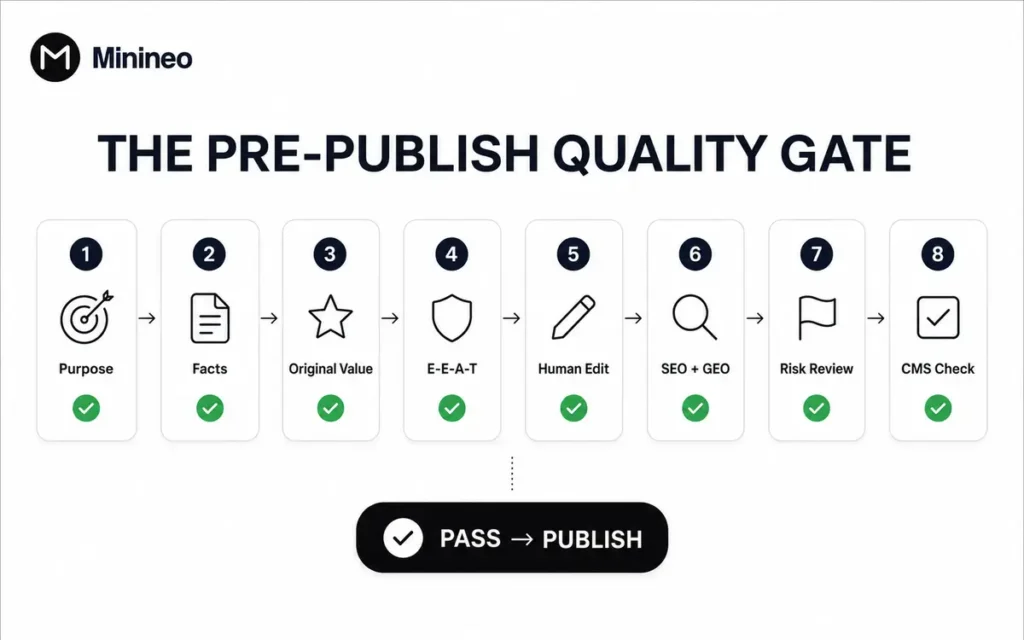
Use this AI-generated content quality checklist as the approval gate between drafting and publishing. It covers the article itself, its sources, E-E-A-T, SEO, GEO, legal and brand risks, and the final CMS preview.
The short version: Do not publish an AI-assisted article until it is accurate, useful, original, clearly authored, naturally written, technically accessible and reviewed by someone accountable for the result.
An AI content quality checklist is a repeatable set of editorial, factual, SEO, GEO and technical checks applied before AI-assisted content goes live. Its purpose is to produce a clear decision: publish, revise, rewrite or escalate for specialist review.
Some teams call this an AI content QA checklist or a pre-publish content checklist. The label matters less than whether a failed check actually stops the page from going live.
How to use this checklist
For each applicable item, record Pass, Fix or Not applicable in your editorial worksheet, CMS task or project board. Add the reviewer’s name and date when several people work on the same page.
Do not turn the checklist into a simple percentage. A perfect title tag cannot compensate for a fabricated statistic, an unsupported medical claim or an accidental noindex directive. Critical failures stop publication regardless of how many other checks pass.
Stop publication if any of these checks fail
- The page answers a real audience need and does not duplicate an existing page with the same intent.
- Every material fact, statistic, quote, product detail and recommendation has been verified.
- No source, person, study, customer story or first-hand experience has been invented.
- The page adds useful original value instead of merely rewriting existing sources.
- High-stakes claims have been reviewed by an appropriately qualified person.
- Copyright, privacy, permission and disclosure requirements have been addressed.
- A named human owns the final approval.
- The live page can be crawled and indexed if organic visibility is intended.
If one of these items fails, fix the issue, change the scope or do not publish the page.
1. Confirm the purpose and search intent
AI can produce a competent article about the wrong question. Check intent before spending time on sentence-level edits.
- The intended reader is clearly defined.
- The page addresses one primary problem or decision.
- The format matches the intent: explanation, process, checklist, comparison, review or landing page.
- The opening gives the reader a useful answer without a long introduction.
- The article covers the information needed to complete the reader’s task.
- Sections that do not help that task have been removed.
- The call to action is a logical next step rather than an interruption.
- Existing content on the site has been checked for overlap.
That last check matters. Before creating a new URL, search your content library and run a site:yourdomain.com query for the topic. If an existing page serves the same intent, updating or consolidating it may be better than publishing a competing article.
Google’s people-first content guidance asks whether an intended audience would find the content useful, whether readers will learn enough to achieve their goal and whether the page offers a satisfying experience. Those are better questions than “Did we reach the target word count?” The Google SEO Starter Guide explicitly says there is no preferred minimum or maximum length for ranking.
2. Verify facts, claims and sources
Fact-checking means more than adding links. The source must exist, be credible for the claim and support the wording used in the article.
- Every number includes enough context to interpret it correctly.
- Statistics are supported by the original study, dataset, filing or official source where possible.
- Dates and time-sensitive statements are current as of the review date.
- Product features, prices, availability and policies have been checked on current official pages.
- Names, titles, company details and quotations are accurate.
- Each citation opens and supports the sentence beside it.
- Secondary reporting is not presented as original research.
- Conflicting evidence or important uncertainty is acknowledged.
- Superlatives such as “best,” “largest,” “only” or “guaranteed” are supported or removed.
- Medical, legal, financial, safety and other consequential claims have expert review.
Use a simple verification log while editing:
| Claim | Best available source | Verified on | Decision |
|---|---|---|---|
| Exact statistic or statement | Direct URL or internal evidence | Date | Keep, qualify, update or remove |
Open every important source. A citation supplied by an AI model may lead to a real page that does not support the claim, an outdated page or a URL that never existed. Do not cite a source based only on its title or a search-result snippet.
Prefer primary sources for platform rules, laws, technical requirements, financial results and research findings. Use reputable secondary sources when they add reporting or interpretation, and describe them accurately. If a fact cannot be verified, remove it or label the uncertainty instead of making the sentence sound more confident.
3. Check originality and added value
Passing a plagiarism scan does not make a page original. A draft can use different wording and still add nothing beyond the pages it summarizes.
- The article contains a clear insight, method, example or conclusion that is specific to the publisher.
- Any first-hand experience is genuine and attributable to the person or team that had it.
- Examples are concrete enough to teach something.
- The page explains meaningful trade-offs, limitations or exceptions.
- Source material has been analyzed rather than paraphrased section by section.
- The article offers substantial additional value compared with the pages already ranking for the topic.
- Similar wording has been checked where copying is a realistic risk.
- The draft is not one of many lightly varied pages produced only to capture search traffic.
Original value does not always require proprietary research. It can come from a tested workflow, a useful decision framework, a screenshot of a real process, an expert explanation, a customer question, a carefully reasoned comparison or a mistake the team learned from.
Do not manufacture experience. Replace unsupported phrases such as “we tested,” “our customers found” or “in our experience” unless the underlying work actually happened and can be explained. Honest synthesis is more trustworthy than fictional authority.
Google’s guidance for generative AI search calls for valuable, non-commodity content and tells publishers not to recycle what existing pages or a generative AI system could readily produce. Its guidance on AI-generated content says generating many pages without adding value may violate the scaled content abuse policy. The issue is not the tool; it is publishing unoriginal content primarily to manipulate search results.
For a closer look at the failure patterns this gate is designed to catch, read Why AI-Written Content Fails to Rank.
4. Strengthen E-E-A-T and reader trust
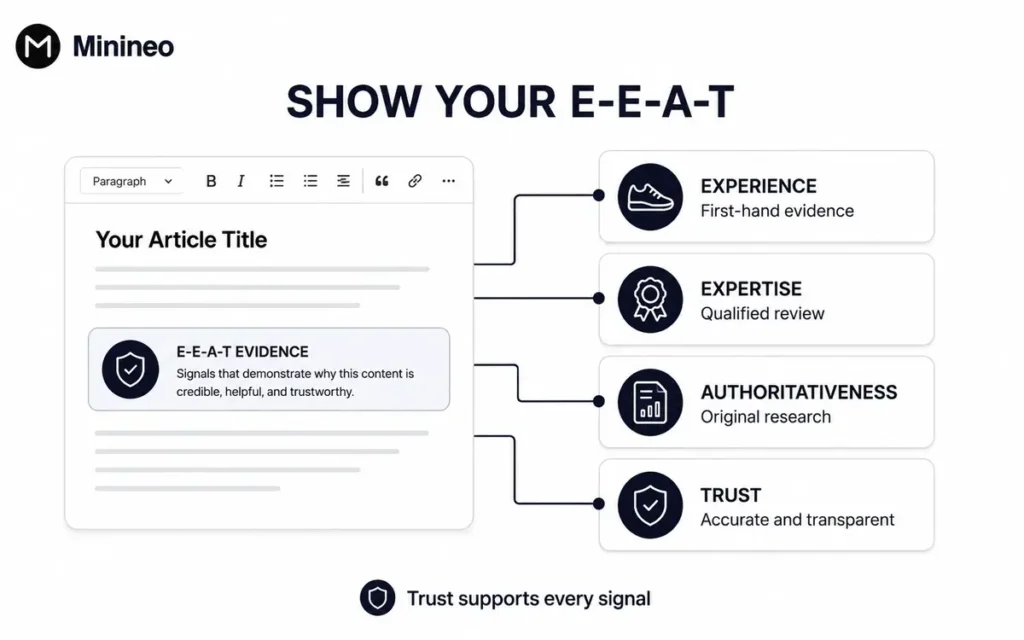
E-E-A-T stands for experience, expertise, authoritativeness and trustworthiness. In its people-first content guidance, Google describes it as a quality framework rather than a single ranking score, says trust is the most important element and clarifies that E-E-A-T itself is not a specific ranking factor.
- A real author or responsible organization is identified.
- The byline links to useful information about the author’s relevant background.
- A qualified reviewer is named when the topic requires additional expertise.
- Claims of experience or expertise are demonstrated in the content.
- Sources are visible near the claims they support.
- The publication date and genuine update date are displayed accurately.
- Commercial relationships, sponsorships and affiliate interests are disclosed where relevant.
- Readers can find an About page, contact information and other basic trust signals.
- The article distinguishes fact, analysis, opinion and prediction.
- Corrections can be made when reliable new information appears.
A byline alone does not establish credibility. The article should show why the author or reviewer is qualified through accurate explanations, first-hand evidence, transparent sourcing and appropriate limits on what they claim.
Google recommends considering the Who, How and Why of content: who created it, how it was produced and why it exists. If automation played a substantial role and readers would reasonably want to know how the page was created, a useful disclosure can add context. This is not a universal instruction to place the same AI label on every article; the disclosure should fit the content, audience and applicable rules.
5. Complete a real human edit
A human edit is not a spelling pass. The editor must improve judgment, accuracy, emphasis and voice.
- The article sounds consistent with the brand, not with a generic assistant.
- The opening begins with substance rather than broad scene-setting.
- Repeated points, summaries and transitions have been removed.
- Vague claims have been replaced with names, numbers, examples or clear reasoning.
- Sentence and paragraph lengths vary naturally.
- Headings help readers predict what each section contains.
- Terminology, capitalization, spelling style and product names are consistent.
- Pronouns and references have clear subjects.
- The tone fits the reader’s knowledge and the seriousness of the topic.
- The article has been read aloud or reviewed in a rendered preview.
Watch for phrases that hide weak thinking:
- “Studies show” without naming a study
- “Experts agree” without identifying relevant experts
- “In today’s rapidly changing world” before an unrelated point
- “It is important to note” followed by something unimportant
- “Revolutionary,” “game-changing” or “seamless” without evidence
- A conclusion that repeats the introduction without adding a decision or next step
Do not replace one rigid style formula with another. Contractions are not automatically unprofessional. A sentence is not bad merely because it exceeds 20 words. A section does not need a table simply to meet a quota. Edit for clarity, rhythm and reader comprehension.
For a deeper editing process, use Minineo’s guide to humanizing AI content for Google SEO.
6. Run the on-page SEO checklist
SEO helps search engines understand and surface a useful page. It cannot turn an inaccurate or derivative article into a good one.
- The title is unique, descriptive, concise and faithful to the page.
- The H1 clearly states the main topic.
- The URL is short, readable and stable.
- The primary topic appears naturally in the opening and relevant headings.
- Related terms are used only where they improve meaning.
- The meta description is a useful, page-specific summary.
- Internal links connect readers to genuinely relevant pages.
- External links point to trustworthy supporting sources.
- Anchor text describes what readers will find after clicking.
- Images are relevant, high quality and accompanied by descriptive alt text when appropriate.
- A canonical URL is set correctly when duplicate or near-duplicate URLs may exist.
- Indexing and crawling controls match the page’s intended visibility.
- Applicable structured data is valid and matches the visible content.
The Google SEO Starter Guide recommends clear titles, useful descriptions, descriptive URLs, readable organization, relevant links and helpful alt text. It does not prescribe a magical word count, heading count or keyword density. Keyword stuffing violates Google’s spam policies.
For a blog post, Google’s Article structured data documentation recommends properties such as the author, author URL, publication date, modification date, headline and representative images. Its general structured data guidelines require markup to represent visible page content rather than misleading or hidden information added only for search features.
7. Make the page GEO and answer-engine friendly
Generative engine optimization should make the page easier to understand and verify. It should not turn the article into a collection of unnatural “AI-friendly” fragments.
- The main question receives a direct, self-contained answer near the beginning.
- Important terms, products and organizations are named consistently.
- Factual statements are specific enough to verify.
- Sources are linked beside the claims they support.
- Lists, tables and definitions are used when they make information clearer.
- Important information appears as accessible text, not only inside an image or video.
- Product, pricing, location and company details match authoritative first-party pages.
- The article includes useful nuance instead of presenting every recommendation as universal.
- The site has not created near-duplicate pages for every query or prompt variation.
- The page is internally linked and accessible to the crawlers the publisher intends to allow.
For Google’s AI Overviews and AI Mode, GEO is not a separate technical checklist. Google’s generative AI optimization guide says the same foundational SEO practices still apply and describes optimization for its generative search features as part of SEO. Its AI features documentation says important content should be available in text and structured data should match the visible page. Google does not require llms.txt, special AI markup, artificial content “chunking” or a rewritten page for every long-tail query variation.
Clear structure may help a system interpret the page, but no format guarantees an AI citation. Do not add an FAQ, table or definition solely because someone claims it is an AI ranking factor. Add it when it resolves a real reader question better than ordinary prose.
For more detail, read Minineo’s guide to optimizing content for AI search engines.
8. Review brand, legal and safety risks
The appropriate review depends on the content and jurisdiction. A general blog post and a page making medical, financial or contractual claims should not share the same approval process.
- No confidential, personal or customer information has been exposed.
- Customer names, quotations, testimonials and logos have the necessary permission.
- Images, charts, code, data and quoted text are owned, licensed or used with appropriate permission.
- Competitor statements are factual, fair and supportable.
- Sponsored, affiliate or commercial relationships are disclosed where required.
- AI involvement is disclosed when required by law, platform policy, contract or reasonable reader expectation.
- Regulated or high-stakes claims have expert, compliance or legal review.
- Advice includes appropriate limits and does not promise outcomes the evidence cannot support.
- The content follows the publishing platform’s current policies.
Do not ask an AI system to make the final legal or compliance decision about its own output. It can help identify claims for review, but the accountable person or qualified adviser must approve them.
9. Check the page inside the CMS
The document can be correct while the published page is broken. Complete the last review in the environment where readers will see it.
- The desktop and mobile previews are readable.
- The title, byline, dates and author profile display correctly.
- Headings, lists, tables, quotations and code blocks render as intended.
- Images load, captions are accurate and alt text is saved.
- Internal and external links open the intended destinations.
- The call to action, form, download or checkout works.
- The canonical URL, robots directives and index status are correct.
- Structured data passes the relevant validator and matches the page.
- Social sharing title, description and image are suitable.
- Analytics and conversion tracking are configured where needed.
- The page has an owner and review date if information may become outdated.
Preview the actual page rather than approving only a document. Mobile layout problems, broken anchors, accidental noindex tags and missing images are publishing failures even when the writing is excellent.
A practical review workflow for teams
Assign responsibility instead of asking one person to “check everything.” The same person may hold several roles on a small team, but each decision should still be explicit.
| Review pass | Primary owner | Main responsibility |
|---|---|---|
| Editorial review | Content editor | Intent, completeness, originality, voice and structure |
| Evidence review | Subject-matter expert or fact-checker | Claims, sources, nuance and high-stakes accuracy |
| Search review | SEO or content lead | Titles, links, metadata, crawlability, schema and GEO clarity |
| Risk review | Legal, compliance or accountable manager when needed | Rights, disclosures, privacy and regulated claims |
| Publication review | CMS owner | Rendering, links, controls, forms and tracking |
AI can support each pass by highlighting unsupported claims, repeated wording, broken links or missing metadata. It should not be the only reviewer. The final approval requires human judgment and accountability.
Publish, revise, rewrite or escalate?
Use the checklist to make a decision, not to generate a decorative score.
| Result | Decision |
|---|---|
| All critical and applicable checks pass | Publish |
| Critical checks pass, but ordinary checks need work | Revise and run the failed sections again |
| The page misses intent or lacks original value | Return to the brief and rewrite |
| A material claim cannot be verified | Remove, qualify or replace the claim |
| The topic creates legal, safety or regulatory risk | Escalate to a qualified reviewer |
| The page duplicates an existing article | Consolidate, redirect or choose a distinct intent |
This approach avoids false precision. An article is not safe because it scored 92 out of 100 if the missing eight points include a fabricated quotation.
Frequently asked questions
Google’s guidance on generative AI content focuses on accuracy, quality, relevance and value rather than banning content because generative AI helped create it. However, producing many unoriginal pages without adding value may violate its scaled content abuse policy.
There is no reliable percentage. The required work depends on the draft, topic and risk. Human review is sufficient only when the final editor can stand behind the facts, reasoning, originality, tone and published page.
AI can assist with a first pass, such as identifying repeated language, extracting claims for verification or checking whether required sections are present. It should not be the sole fact-checker, expert reviewer or final approver.
Not necessarily. Consider the law, platform rules, contracts, brand policy and what readers would reasonably expect to know. Google’s people-first content guidance recommends giving readers context about how content was created when that information would be useful.
No. A draft can be free of copied sentences while offering no new value. Originality also requires useful analysis, evidence, experience, examples or conclusions that distinguish the page from a generic summary.
Trust. If readers cannot trust the facts, sources, author or intent, formatting and SEO improvements do not rescue the page. Accuracy and honest accountability should always be release-blocking requirements.
Use the checklist as a publishing gate
The purpose of an AI content checklist is not to hide AI fingerprints. It is to stop weak, inaccurate or unnecessary pages from reaching readers.
Begin with intent. Verify every material claim. Add something worth publishing. Show who is responsible. Edit the article until it sounds natural and precise. Then check its SEO, GEO, permissions and live-page setup.
That process takes more effort than clicking “generate and publish,” but it protects the brand and gives the content a reason to exist.
Use this checklist as the human approval step after drafting and before publishing. Minineo can generate SEO- and GEO-ready content and publish it to connected channels; the checks above help ensure the final page is accurate, useful and ready to carry its author’s name.