Choose prompts for AI visibility tracking by starting with the questions a potential customer asks before selecting a product, service or brand.
A useful prompt set should cover unbranded discovery, customer problems, use cases, comparisons, alternatives and branded trust questions. The prompts should be natural, commercially relevant and stable enough to run repeatedly. If the prompts are too broad, leading or heavily branded, the resulting visibility score may look encouraging while revealing very little about whether new customers can actually discover you.
What is an AI visibility tracking prompt?
An AI visibility tracking prompt is a question submitted repeatedly to an AI answer engine to measure whether, where and how a brand appears in the response.
For example:
What are the best AI content platforms for a small marketing team that publishes to WordPress?
This prompt can reveal more than whether a brand is mentioned. It can also show:
- Which competitors are recommended
- Whether the brand is described accurately
- Whether the response links to the brand’s website
- Which third-party sources are cited
- What strengths or weaknesses the answer associates with each option
- Whether the result changes across ChatGPT, Gemini, Claude, Perplexity or another relevant answer engine
AI visibility tracking is therefore closer to a structured, recurring market test than conventional keyword rank tracking.
Why prompt selection matters
Your prompt set defines what your AI visibility score actually measures.
If every prompt contains your brand name, you are mostly testing whether the AI system recognizes your brand. You are not testing whether it recommends you when a buyer does not already know you. At the other extreme, a prompt such as “What is the best software?” is too broad to represent a meaningful market.
Good prompts sit between those extremes. They describe a recognizable need, audience, category or constraint without forcing the AI system toward a predetermined answer.
Prompt wording also affects the retrieval task. Google’s AI features documentation explains that AI search may use query fan-out, issuing related searches across subtopics and sources to answer a nuanced question. Different AI systems can also return different responses and links. This makes specificity useful, but it also makes consistency essential when comparing results over time.
OpenAI’s evaluation best practices describe generative AI systems as nondeterministic and recommend task-specific tests that reflect real-world usage, continuous measurement and human review alongside automated scores. Those principles apply directly to AI visibility tracking.
Start with the business questions you need to answer
Do not begin by asking, “Which 100 prompts can we track?” Begin with the decisions the data should support.
Common AI visibility goals include:
- Category discovery: Does the brand appear when buyers ask for solutions in its category?
- Problem association: Does the AI connect the brand with the problem it solves?
- Use-case relevance: Is the brand recommended for its priority audiences and applications?
- Competitive positioning: How is the brand compared with key competitors?
- Reputation and accuracy: Is the brand described correctly and fairly?
- Geographic visibility: Does the brand appear in the countries or cities it serves?
A B2B SaaS company may care most about comparison and integration prompts. An ecommerce brand may care more about product recommendations, budgets and use cases. A local business should add genuine location and service-area context.
The prompt portfolio should reflect how the business wins customers, not a generic GEO checklist.
Where to find realistic AI visibility prompts
The best prompt ideas usually already exist inside the business. Look for repeated questions in:
- Sales calls and product demos
- Customer support tickets and live chats
- Website search data
- Google Search Console queries
- Product reviews and survey responses
- Community discussions and relevant forums
- Competitor comparison requests
- Questions asked before a customer converts
Search keywords can provide useful raw material, but they should usually be rewritten as natural questions. A person might type “AI blog generator WordPress” into Google, but ask an assistant:
Which AI blog generator can create SEO articles and publish them directly to WordPress?
The second version contains the same commercial need in a more realistic conversational form.
The six prompt types every brand should consider
A balanced prompt set should include multiple intent types. The exact mix depends on your market, but the following six groups provide a practical foundation.
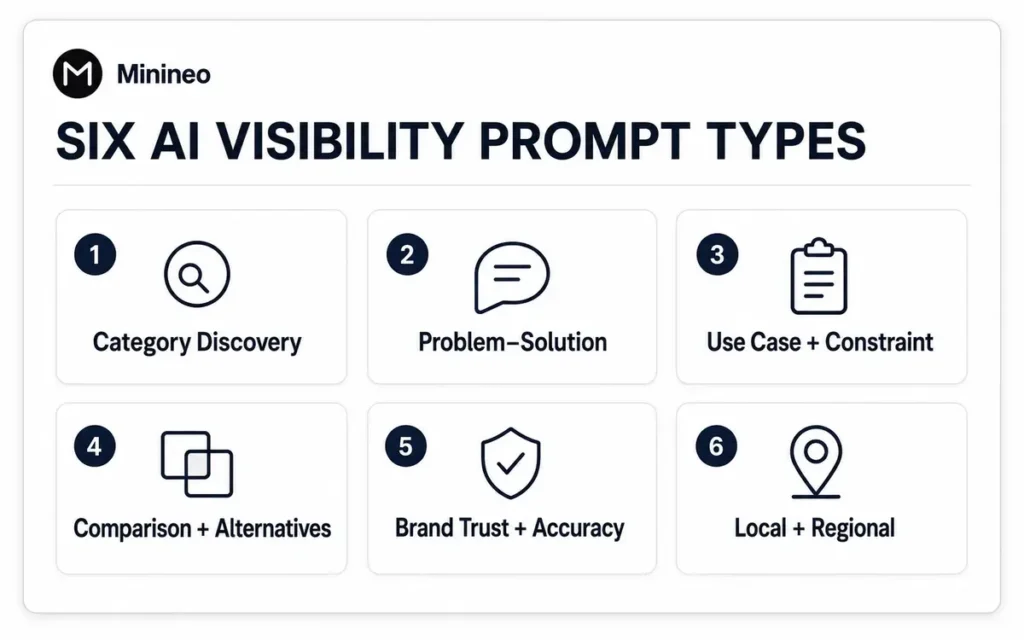
| Prompt type | What it measures | Template | Example |
|---|---|---|---|
| Category discovery | Whether new buyers find you | What are the best [category] for [audience]? | What are the best AI marketing platforms for small teams? |
| Problem-solution | Whether the brand is associated with a need | What tools can help [audience] solve [problem]? | What tools can help a small team publish SEO content consistently? |
| Use case and constraints | Relevance for a specific requirement | Which [category] supports [use case or constraint]? | Which AI content tools publish directly to WordPress and Shopify? |
| Comparison and alternatives | Competitive positioning | How do [brand] and [competitor] compare for [use case]? | How do Minineo and Jasper compare for SEO content publishing? |
| Branded trust and accuracy | Brand understanding and reputation | Is [brand] suitable for [audience or use case]? | Is Minineo suitable for agencies managing content for clients? |
| Local or regional | Visibility in a genuine market | What are the best [category] for businesses in [location]? | What are the best affordable AI SEO platforms for Indian startups? |
1. Category discovery prompts
Category prompts test whether your brand enters the consideration set before the buyer knows it exists.
Examples:
- What are the best inventory management tools for small ecommerce businesses?
- Which email marketing platforms are suitable for early-stage SaaS companies?
- Recommend AI SEO platforms for a small marketing team.
These are usually the most valuable prompts for measuring organic discovery. Keep the brand name out of them.
2. Problem-solution prompts
Customers do not always know the name of the product category. They often describe the job they need to complete.
Examples:
- How can a Shopify store publish useful blog content every week with a small team?
- What tools can help a SaaS company monitor how ChatGPT describes its brand?
- How can a local business find and fix content gaps on its website?
Problem prompts help identify whether AI systems connect your brand with the outcome it delivers.
3. Use-case and constraint prompts
Generic category visibility can look strong while hiding poor visibility among your most valuable customers. Add constraints that reflect real purchasing criteria.
Useful constraints include:
- Audience or company size
- Industry
- Required integration
- Budget range
- Geography or language
- Specific workflow
- Product capability
For example, “best AI writing tools” is broad. “Which AI content platforms publish directly to WordPress and include Search Console tracking?” is narrower, but far more commercially meaningful.
Only include constraints that real buyers care about. Packing every feature into one prompt creates an unnatural test.
4. Comparison and alternative prompts
Comparison prompts reveal the attributes AI systems use to distinguish your brand from competitors.
Examples:
- Minineo vs Jasper: which is better for SEO content and WordPress publishing?
- What are affordable alternatives to [competitor] for a small team?
- Compare [brand A], [brand B] and [brand C] for [use case].
Track whether the answer is factually correct, not just whether your brand “wins.” An inaccurate recommendation can be more damaging than no mention at all.
5. Branded trust and accuracy prompts
Branded prompts are useful, but they measure a different stage of the journey. They show what a buyer may find after hearing about you elsewhere.
Examples:
- What is [brand] known for?
- Is [brand] suitable for [specific use case]?
- What are the main strengths and limitations of [brand]?
- How does [brand] pricing work?
Use these prompts to monitor entity understanding, product facts, reputation and outdated information. Do not mix them with unbranded discovery prompts when calculating a discovery score.
6. Local and regional prompts
Use geographic qualifiers only when location materially changes the answer.
Examples:
- What are the best logistics platforms for ecommerce sellers in India?
- Recommend accounting software for a small business in Bengaluru.
- Which home-service companies operate in Gurugram and offer same-day bookings?
Location is not a cosmetic keyword. OpenAI’s web-search documentation shows that the API supports approximate user location to refine results, so automated regional tracking should log geography and hold it consistent.
How to write a strong AI visibility prompt
Use the following formula as a starting point:
[Natural question or task] + [category/problem] + [audience or use case] + [one important constraint]
For example:
Which AI content platform is suitable for a small ecommerce team that needs direct Shopify publishing?
A strong tracking prompt should meet five tests:
- Realistic: A potential buyer could plausibly ask it.
- Relevant: The answer could influence discovery, evaluation or purchase.
- Neutral: It does not tell the AI which brand should win.
- Focused: It tests one clear intent rather than several unrelated needs.
- Repeatable: The wording can remain unchanged across measurement periods.
Good prompts versus misleading prompts
| Avoid | Better version | Why it is better |
|---|---|---|
| Why is Acme the best CRM? | Which CRM is suitable for a 20-person B2B sales team, and why? | Removes the leading assumption |
| Tell me about Acme. | What are the best CRMs for a 20-person B2B sales team? | Tests unbranded discovery |
| Best software | What are the best inventory tools for a small Shopify store? | Defines the category and audience |
| List every AI SEO tool | Recommend up to five AI SEO platforms for a small marketing team. | Creates a realistic consideration set |
| Which tool is cheap, powerful, secure, fast, easy and works everywhere? | Which affordable email platform supports automation for an early-stage SaaS company? | Tests one coherent buying need |
| Best CRM India, top CRM software, CRM tools | Which CRM platforms are suitable for Indian SMB sales teams? | Uses natural language rather than keyword fragments |
How many prompts should you track?
There is no universal correct number. A focused set of 20 commercially meaningful prompts is usually more useful than 200 loosely related questions.
For a first tracking set, consider this practical allocation:
| Intent group | Suggested starting prompts |
|---|---|
| Category discovery | 4 |
| Problem-solution | 4 |
| Use cases and constraints | 4 |
| Comparisons and alternatives | 4 |
| Branded trust and accuracy | 2 |
| Geographic or regional | 2 |
| Total | 20 |
This is a starting framework, not an industry benchmark. A brand with several products, audiences or countries may need separate prompt sets. Split those sets by product or market instead of combining everything into one opaque score.
How to prioritize prompts
Score each candidate prompt from 1 to 3 on four dimensions:
- Customer realism: Do customers genuinely ask this question?
- Commercial value: Could the answer influence revenue or consideration?
- Strategic relevance: Does it represent a product, audience or market you want to grow?
- Diagnostic value: Would a poor result tell you what to improve?
Prioritize prompts with the highest total score. If two prompts express nearly the same intent, retain the version that sounds most natural and move the other into a secondary test set.
Prompt variations can be useful, but they should be intentional. “Best CRM for startups” and “Which CRM should a 10-person SaaS company use?” may test related but meaningfully different contexts. Changing only one word to manufacture a larger prompt count adds little insight.
Separate the baseline set from experimental prompts
Maintain two groups:
Baseline prompts
These are your stable measurement set. Keep their wording and evaluation rules unchanged so results can be compared over time.
Experimental prompts
Use these to explore a new product, customer segment, competitor or emerging question. Promote an experimental prompt into the baseline only when it proves strategically useful.
Version any material change. If “best accounting software for small businesses” becomes “best GST accounting software for Indian small businesses,” it is a new prompt measuring a different market, not a simple edit to the old one.
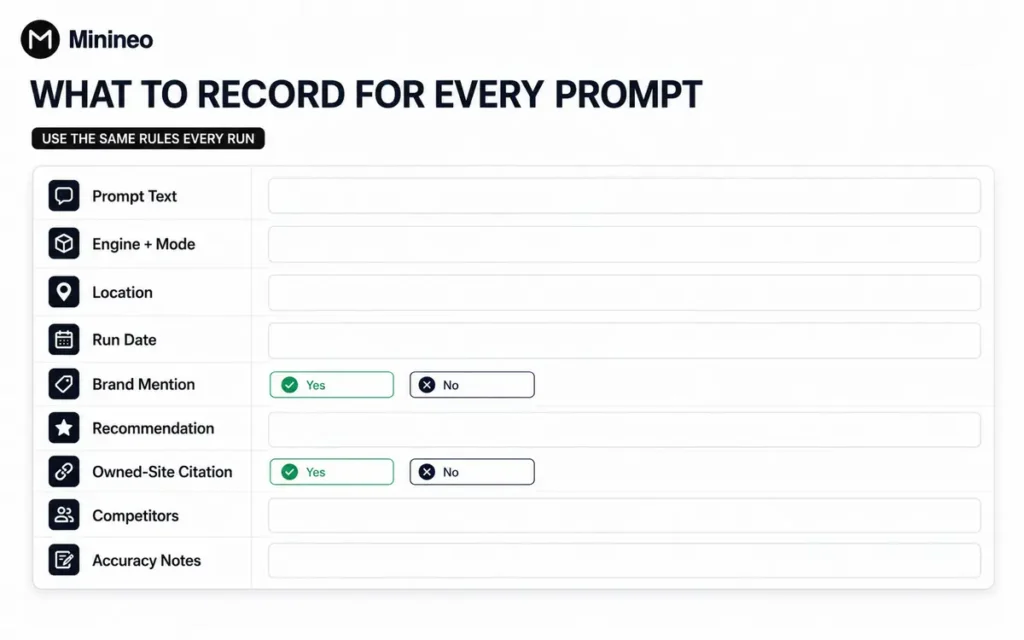
What to record for every prompt
Do not reduce an AI answer to a single yes-or-no mention. Capture the following fields:
| Field | What to record |
|---|---|
| Prompt | Exact wording and version |
| Platform | ChatGPT, Gemini, Claude, Perplexity or another selected engine |
| Surface or mode | For example, ChatGPT Search, the Gemini app, Claude with web search or Perplexity search |
| Date and time | When the test ran |
| Market and language | Country, city if relevant, and response language |
| Brand mention | Whether the brand appeared |
| Recommendation | Whether the answer actively recommended the brand |
| Citation | Whether the brand’s site or another relevant page was linked |
| Competitors | Which competing brands appeared |
| Description | How the answer positioned the brand |
| Accuracy | Whether important product facts were correct |
| Sentiment | Positive, neutral, mixed or negative framing |
| Sources | URLs or domains referenced in the response |
Mentions and citations should remain separate. A model can mention a brand without linking to its website, or cite a source that discusses the brand without recommending it. For API-based web search, OpenAI’s web-search documentation distinguishes the complete list of sources consulted from the smaller set surfaced as inline citations.
For Claude, record whether web search was enabled. Anthropic’s Claude web-search guide says searched responses draw on live web content and include citations; comparing those answers with non-search responses as if they were identical would make the trend unreliable. Perplexity explains that it searches the web in real time and includes citations in each answer, so cited domains should be recorded as first-class visibility signals.
Useful AI visibility metrics
Once the evaluation rules are consistent, calculate a small number of transparent metrics.
Mention rate
Mention rate = responses mentioning your brand ÷ valid responses × 100
Recommendation rate
Recommendation rate = responses explicitly recommending your brand ÷ valid recommendation-intent responses × 100
Owned-site citation rate
Owned-site citation rate = responses linking to your website ÷ valid responses × 100
Prompt coverage
Prompt coverage = unique tracked prompts where your brand appeared ÷ total tracked prompts × 100
Competitive share of voice
One defensible method is:
AI share of voice = your brand appearances ÷ appearances of all tracked brands × 100
Count each brand at most once per response so a long answer does not inflate the result. Document the formula and keep it unchanged. Different tools may define an “AI visibility score” differently, so the score is useful as a trend within one methodology, not as a universal ranking factor.
How often should prompts be checked?
Use a cadence that matches how quickly the market changes and how important the prompt is.
- Run high-value category and comparison prompts weekly if they influence active campaigns.
- Review the full baseline monthly for strategic reporting.
- Run an additional check after a major product launch, rebrand, pricing change or website migration.
- For critical prompts, collect more than one response per measurement period when resources permit.
- Compare trends across several runs before declaring an improvement or decline.
Generated answers can vary even when the prompt remains the same. A repeated process reduces the risk of reacting to one unusual response. Run baseline prompts in fresh, isolated conversations unless you are intentionally testing a multi-turn journey. Keep the platform, surface or search mode, prompt, country, language and scoring rules consistent, and review the underlying answer whenever a score moves sharply.
A worked example for an AI content platform
Suppose an AI content platform wants to be discovered by small marketing teams that publish to WordPress and Shopify.
A weak tracking set might contain:
- What is Minineo?
- Is Minineo good?
- Why should I use Minineo?
These prompts can test brand recognition, but all of them assume the buyer already knows the product.
A stronger set would include:
- What are the best AI content platforms for a small marketing team?
- Which AI blog generators publish directly to WordPress?
- How can a Shopify store create and publish SEO blog posts with a small team?
- Which AI marketing platforms combine content generation, publishing and analytics?
- What are affordable alternatives to Jasper for SEO content production?
- Minineo vs Jasper: which is more suitable for direct WordPress publishing?
- Is Minineo suitable for agencies managing content for multiple clients?
- What are the main strengths and limitations of Minineo?
This mix measures discovery, problem association, feature relevance, competitive positioning and branded accuracy. It also gives the marketing team clearer next actions when visibility is weak.
Run the same stable prompt set separately across the platforms selected for the audience, such as ChatGPT, Gemini, Claude or Perplexity. For platforms with optional search modes, document whether web search was used. Review mentions, recommendations, citations and competitors by platform before calculating any blended view.
According to Minineo’s product guide, its AI Visibility Checker currently uses prompt-based testing across ChatGPT and Gemini, allowing brands to see whether they appear for questions relevant to their category and compare that presence with competitors. The same prompt-selection method can also be applied when tracking additional platforms such as Claude or Perplexity.
Common mistakes when choosing tracking prompts
Tracking only branded questions
Branded prompts measure recognition and accuracy, not whether new buyers discover you. Keep them in a separate group.
Using generic prompts with no commercial context
“Best marketing software” could produce dozens of valid categories. Add a real audience, problem or use case.
Writing leading prompts
Prompts such as “Why is our product better?” bias the task. Use neutral wording when measuring competitive visibility.
Changing prompts every reporting period
If the question changes, the result is no longer directly comparable. Version changes and preserve the historical baseline.
Treating a mention as a recommendation
A brand may appear in a warning, a comparison or a list of alternatives. Read the framing before counting the result as positive visibility.
Combining all engines and markets into one number
Each selected platform should be evaluated separately before creating any blended score. Product surface, country and language results should also remain distinguishable.
Ignoring factual accuracy
An answer may mention the brand but describe an old feature, wrong price or unavailable market. Accuracy is a core visibility metric, not a minor detail.
Treating prompt tracking as actual demand data
Prompt tracking shows how AI systems respond to selected questions. It does not tell you how many people asked those questions. Use Search Console, analytics, sales data and customer research alongside AI visibility results.
Assuming a tool has access to an AI engine’s internal ranking system
Third-party tools observe outputs; they do not have access to a platform’s hidden ranking logic. Google’s generative AI optimization guide explicitly advises caution around tools that claim access to internal Google metrics.
Turn prompt results into action
Each visibility gap should lead to a specific investigation.
| What you observe | What it may indicate | Next step |
|---|---|---|
| Competitors appear on unbranded prompts, but you do not | Weak category or use-case association | Compare the cited sources and improve relevant first-party and third-party coverage |
| Your brand appears but is described incorrectly | Inconsistent or outdated public information | Correct product pages, profiles, documentation and authoritative listings |
| Your brand is mentioned but never cited | Weak source eligibility or insufficiently useful pages | Check crawl access, indexability and the pages competing for the prompt |
| Visibility is strong only on branded prompts | Recognition without category discovery | Build content and authority around unbranded customer problems and use cases |
| One engine finds you and another does not | Different retrieval systems or source coverage | Review results and cited domains separately for each engine |
| Results vary sharply between runs | An unstable or overly broad prompt | Narrow the intent and evaluate the trend across repeated runs |
OpenAI’s crawler documentation identifies OAI-SearchBot as the crawler used to surface websites in ChatGPT search results. It is separate from GPTBot, which relates to potential model training. Allowing OAI-SearchBot makes a site eligible, but does not guarantee placement.
Google’s AI features guidance says the same foundational SEO practices remain relevant: useful people-first content, crawlability, internal links, visible textual information and structured data that matches the page. Google does not require special AI markup to appear.
If your prompt results reveal content or technical gaps, read Minineo’s guides to optimizing content for AI search and comparing AI visibility tools.
AI visibility prompt checklist
Before adding a prompt to your baseline, confirm that:
- A real customer could plausibly ask it
- It maps to a defined product, audience, problem or market
- The result could influence a business decision
- It contains only necessary context
- It is neutral and does not force your brand into the answer
- It is labeled as discovery, problem, use case, comparison, branded or regional
- Its location and language are defined when relevant
- It is not a duplicate of another prompt
- The exact wording can remain stable
- Mention, recommendation, citation and accuracy can be scored consistently
Build a prompt set that supports decisions
The best prompts for AI visibility tracking are not the ones that mention your brand most often. They are the ones that most accurately represent how customers discover, compare and evaluate solutions.
Start with a small, balanced set of real buyer questions. Separate unbranded discovery from branded accuracy. Keep the baseline stable, review more than the headline score, and use the findings to decide what content, technical information or third-party proof needs improvement.
A disciplined prompt set shows where your brand enters the buying journey, which competitors replace it, whether public information is accurate and what content or authority gap deserves attention next.
Want to see where your brand appears today? Run an AI visibility check with Minineo and test your most important prompts across the ChatGPT and Gemini surfaces it currently supports.
Frequently asked questions
There is no single best prompt. The most useful prompt is a neutral, realistic customer question tied to an important category, problem, use case or comparison. A balanced set is more reliable than one headline query.
Use the brand name for accuracy, reputation and comparison checks. Leave it out when measuring unbranded discovery. Report those two groups separately.
Twenty prompts is a practical starting point for many small businesses, provided they cover multiple intent types. This is a recommended workflow, not a universal benchmark. Quality and commercial relevance matter more than volume.
Run the full baseline monthly and high-value purchase or comparison prompts weekly when needed. Use the same wording and settings, and look for trends across multiple observations.
Generative AI systems are variable, and retrieved sources can also change. Treat a single response as an observation rather than a fixed rank. Repeated, consistent measurement provides a more useful trend.
No. A mention means the brand’s name appeared. A citation means the answer linked to a supporting page or source. A brand can be mentioned without its website being cited.
No. Prompt tracking measures answers to the prompts you selected; it does not provide consumer query volume. Combine it with customer research, Search Console, analytics and sales data.
Review each platform separately first because responses, sources and coverage can differ. A blended score is only useful when its weighting and calculation are clearly documented.