GEO Tools Are Not Just Mention Trackers
A reader asked me last week why their GEO tool kept telling them they weren’t mentioned anywhere, but never told them what to actually change on the page. That’s a fair complaint, and it’s because most tools marketed as GEO tools only do the measuring half of the job. They run your brand name through ChatGPT and Gemini on a schedule and report back a mention count. Useful, but it’s a thermometer, not medicine.
The tools in this article do the other half: checking whether your site’s structure, schema, and crawler access even give an AI engine a fair shot at citing you, and scoring or rewriting your content so it’s actually citable once it’s found. A few go further and connect the finding to the fix directly.
Quick answer: if you want a self-serve technical audit (robots.txt, llms.txt, schema, AI crawler access) with real independent reviews behind it, start with AthenaHQ‘s free tier, or try Gumshoe AI‘s free first audit if you’d rather run a single check than commit to a monthly subscription. If you want content scored and rewritten for AI-readability while you write it, Frase, Surfer SEO, or Clearscope are the established options, each with a genuine GEO-specific feature bolted onto the tool. If you want the audit and the tools to fix what it finds in one dashboard, that’s where Minineo fits.
How I evaluated these tools
Same method as the tracking-tools article: I only counted a tool as GEO, not generic SEO, if it had a feature specifically built around AI-answer-engine citation or AI-readability, not just traditional keyword/topic scoring with AI added to the name. Every price below is linked to the page it came from, and I’ve flagged where a tool’s claims can’t be independently verified (Gumshoe AI, for instance, is new enough that no outside review data exists yet to check its claims against).
1. AthenaHQ
AthenaHQ is a Y Combinator-backed startup that publishes its full pricing self-serve, rare in this space, and has the review count to back up its claims.
Key Features:
- Genuine crawler-access management: configures and monitors robots.txt and llms.txt so AI bots can actually reach your content, per AthenaHQ’s own site
- Content-recommendation engine that identifies specific gaps preventing citation and suggests fixes, restructuring, added FAQs, schema, though independent reviewers note this leans toward guidance rather than automated rewriting, and that it lacks a full technical SEO audit (no Core Web Vitals, no schema validator)
- Essential is free (one-time 300-credit grant, 5 AI models); Starter is $295/month (drops to $245/month if billed annually) for 3,600 credits and 9 AI models including ChatGPT, Perplexity, Google AI Overviews, Google AI Mode, Gemini, Claude, Copilot, and Grok; Enterprise is custom, per AthenaHQ’s pricing page
Best For: teams that want a self-serve, transparently-priced tool with independently verified reviews, rather than a demo-gated enterprise sales process.
Pros:
- Rated 4.9/5 on G2 across 32+ reviews, a genuine independent trust signal most tools in this space don’t have
- Fully public self-serve pricing with a usable free tier
Cons:
- Independent reviewers describe its technical audit as basic compared to dedicated crawlability tools; content fixes are more suggestion than automation
- Young company (founded 2024), small team, and its Create & Publish feature only supports six named platforms (Shopify, Webflow, Wix, Framer, WordPress, Payload CMS)
2. Gumshoe AI
Gumshoe has moved to a tiered monthly subscription with a free trial, rather than the pure per-audit pricing it once had, and it’s worth knowing about even though it’s the newest, smallest name on this list.
Key Features:
- Technical Audit and Technical Score grades individual pages with specific recommendations for JSON-LD markup, schema improvements, and content changes, per Gumshoe’s own site; it’s narrower than a full crawler-access audit, robots.txt and llms.txt aren’t part of the stated scope, unlike AthenaHQ’s
- Monitors brand visibility across 11 AI models, including ChatGPT, Gemini, Claude, Perplexity, DeepSeek, Grok, and Google AI Overviews, and generates gap-targeted content to close visibility gaps it finds
- Runs its test conversations as AI-inferred buyer personas (role, goals, pain points) rather than anonymous prompts, so results reflect how AI actually answers different types of buyers, not just a single generic query
- Free Trial gives a one-time Visibility Audit (4 personas, 5 prompts/persona, 4 AI models) at no cost; Starter is $99/month for a monthly Visibility Audit (8 personas, 10 prompts/persona, 6 models), weekly Snapshot Audits, 10 Technical Audits/month, and 3 AI-generated content pieces/month; Pro is $299/month for the same Visibility Audit plus daily Snapshot Audits, Citation/Content/Sentiment Audits, 50 Technical Audits/month, and 10 content pieces/month, per Gumshoe’s own pricing page
Best For: teams that want an affordable, tiered monthly subscription for ongoing AI visibility monitoring, with a free trial to test it first.
Pros:
- A genuinely free trial (one full Visibility Audit) to test the platform before committing to a paid tier
- The persona-based methodology is a genuinely different approach from tools that just run one generic prompt per topic
- The Technical Score gives a specific, numbered starting point (schema and content fixes) rather than a vague recommendation list
Cons:
- Very new (2025 launch), small team, $2M pre-seed raised, and no independent G2 or Capterra review data exists yet to verify its claims against
- The audit itself doesn’t cover crawler access (robots.txt, llms.txt), so pair it with something else if that’s what you need checked
3. Frase
Frase is a content-optimization tool that’s been around longer than the current GEO wave, and it added a dedicated GEO Score rather than just rebranding its existing SEO score.
Key Features:
- GEO Score (0 to 100) built on three separate checks, per Frase’s own site: Authority (flags missing citations or credible sourcing), Readability (flags passages too dense for an AI system to cleanly extract and quote), and Structure (checks heading clarity and whether sections are standalone enough to be quoted out of context)
- Starter is $49/month month-to-month ($39/month billed annually) for 10 articles and 50 audit pages, with AI Visibility tracking on ChatGPT and Google AI, 50 tracked prompts; Professional is $129/month month-to-month ($103/month annually) for 40 articles, adding Perplexity to AI Visibility and 200 tracked prompts; Scale is $299/month month-to-month ($239/month annually) for 100 articles, adding Claude and Gemini to AI Visibility and 500 tracked prompts; Enterprise is custom, per Frase’s pricing page
- Also ships a Content Guard feature that watches published pages for Google ranking decay and drafts a fix you approve before it republishes.
Best For: content teams who want AI-readiness scoring built into the writing process itself, not a separate audit step after publishing.
Pros:
- GEO Score is a genuinely separate metric from SEO score, not a relabeled version of it
- Citation tracking (Perplexity, Claude, Gemini added at higher tiers) is bundled into the same plan rather than sold as a completely separate product
- 4.8/5 on G2 with recognizable enterprise customers (Oracle, GitLab, Coursera, Under Armour), plus a 7-day free trial with no credit card required
Cons:
- The exact scoring weights behind Authority/Readability/Structure aren’t disclosed, so you’re trusting a black box
- Entry tier’s 10-article cap is thin for a team publishing regularly
4. Surfer SEO
Surfer built its reputation on traditional NLP-based content scoring, and its AI-answer-engine feature is bolted on top of that core rather than replacing it.
Key Features:
- Discovery is $59/month ($49 billed annually) but includes zero AI visibility tracking at all, per Surfer’s pricing page; Standard is $119/month ($99 annually) and adds AI Tracker limited to ChatGPT only, 25 prompts, refreshed weekly; Pro is $219/month ($182 annually) and expands AI Tracker to 5 engines, ChatGPT, Perplexity, Google AI Mode, Google AI Overview, and Gemini, 50 prompts refreshed daily; Peace of Mind is $359/month ($299 annually) for the same 5 engines at 100 prompts; Enterprise is $999/month, custom-scoped
- AI Tracker (Standard and up) reports a visibility score, mention-gap analysis, and competitor share-of-voice, on top of Surfer’s existing content-scoring engine
- Surfer also sells AI Search Analytics as a standalone product, separate from the content-optimization tiers, priced by a prompt-volume slider rather than a fixed tier: from $82/month (50 tracked prompts refreshed daily) up to $158/month (100 tracked prompts refreshed daily) as tested, both billed yearly; every level includes 5 Brand Workspaces, mention gap and sentiment, visibility score and share of voice, and an unspecified set of key LLM models (not confirmed to match the 5 named engines in Pro/Peace of Mind), per Surfer’s pricing page
- WordPress integration is available from Standard tier up, not on Discovery
Best For: content teams who already use Surfer for traditional SEO and want AI-citation tracking added without switching tools, as long as they’re on Standard or above.
Pros:
- AI Tracker adds citation monitoring without requiring a second subscription, once you’re past the entry tier
- Real third-party validation: 4.8/5 on G2 (500+ reviews), 4.9/5 on Capterra (400+ reviews), and a claimed 150,000+ users
Cons:
- The cheapest plan (Discovery) doesn’t track AI visibility at all, and the next tier up (Standard) only covers ChatGPT with weekly refreshes; you need Pro for daily, multi-engine tracking
- The AI Tracker bundled into the content-optimization tiers is an add-on to a fundamentally traditional-SEO tool, not a purpose-built GEO product, so depth is shallower than Frase’s dedicated score; the standalone AI Search Analytics product is closer to purpose-built, but its key LLM models aren’t named the way the bundled tiers name theirs
- Pricing climbs fast within the content-optimization ladder if you need Pro-tier volume, nearly double Standard for meaningfully more usage, though the standalone AI Search Analytics product avoids this if content tools aren’t needed
5. Clearscope
Clearscope spent years as an enterprise-only, demo-gated content tool. That changed recently, both its pricing and a genuine GEO feature are now public.
Key Features:
- Prompt Tracking, included free on every tier, runs your target prompts against ChatGPT and Gemini and reports the percentage of AI answers that mention or cite your brand, a real citation-rate metric layered onto its existing semantic content grading, per Clearscope’s pricing page
- Query fan-out awareness, also included on every tier, surfaces the sub-searches AI platforms actually trigger to construct an answer, so you can build content that targets those underlying searches rather than just the surface-level prompt
- Essentials is $129/month for 50 tracked prompts and 50 pages, Business is $399/month for 300 tracked prompts, 300 pages, and a dedicated account manager, Enterprise is custom; unlimited users and projects on every tier
Best For: content teams already sold on Clearscope’s content-grading approach who want citation tracking without adding a separate tool.
Pros:
- Prompt Tracking and query fan-out awareness are included, not separate paid add-ons, at every tier, and seats/projects are unlimited regardless of plan
- Pricing is now public, a real change from its old sales-call-only model, and real enterprise customers (Intuit, Adobe, Shopify, Deloitte, IBM) are named on its own site
Cons:
- Still the priciest content-optimization tool on this list at the entry tier
- The content-grading core is unchanged from its pre-GEO product, so you’re paying for citation tracking layered onto an older tool, not a ground-up GEO rebuild
6. Ahrefs AI Content Helper
Ahrefs Brand Radar (covered in our other article) tracks whether you’re mentioned. AI Content Helper is a separate Ahrefs product that helps you write content more likely to earn that mention in the first place.
Key Features:
- Detects multiple search intents for a keyword and grades your draft’s topical coverage against top-ranking pages, surfacing gaps to fill before you publish, per Ahrefs’ own product page
- Also generates titles and meta descriptions and checks heading structure, supports 173+ languages, and adds document-sharing for Enterprise accounts
- Priced in USD across three tiers: Ahrefs Free (1 document/month), AI Content Helper at $99/month (50 documents/month), and Content Kit at $299/month, which raises the same editor’s limit to 250 documents/month and adds a separate AI Content Grader tool, with a third tool, Content Inventory, listed as coming soon
Best For: existing Ahrefs customers who want a content-writing assistant without adopting a whole separate content-ops tool.
Pros:
- Sits inside the Ahrefs ecosystem you may already use for SEO, no new login
- Genuinely free tier, 1 document a month, to try it before paying
Cons:
- It’s a content-writing scorer, not a dedicated GEO score like Frase’s, its AI-search framing is closer to marketing language than a distinct, disclosed methodology
- The entry paid plan caps you at 50 documents a month, scaling up means jumping straight to the $299/mo Content Kit bundle rather than a smaller step
7. Minineo
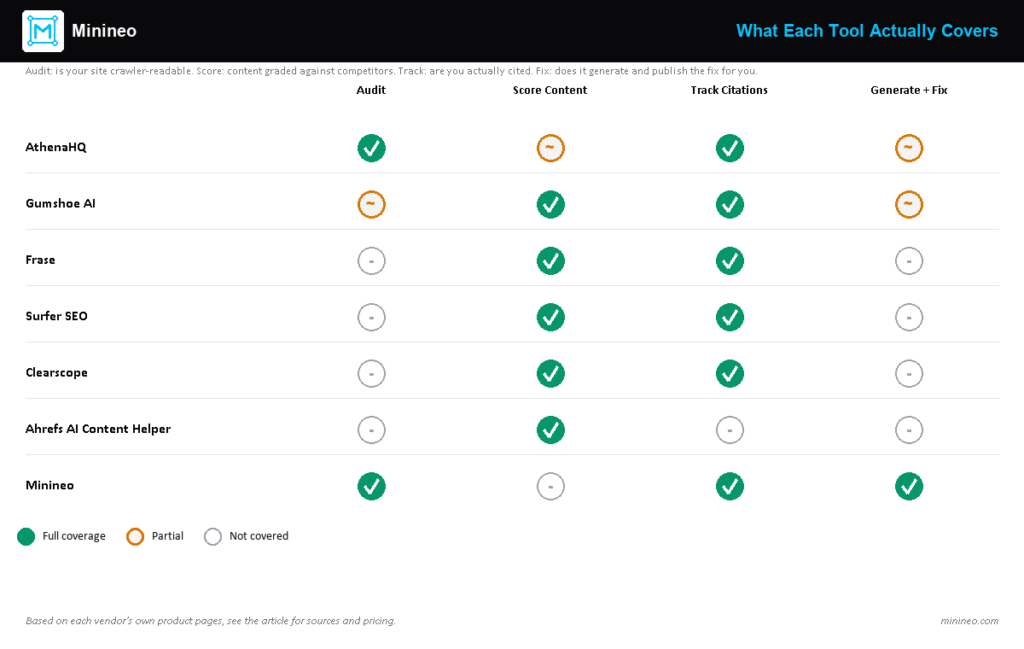
Every tool above does one half of GEO well: AthenaHQ and Gumshoe AI audit the technical side, Frase, Surfer, and Clearscope optimize the content side. None of them close the loop between finding a gap and fixing it without you doing the work manually or buying a second tool. That’s the actual reason Minineo is worth including here rather than just in the tracking-tools list.
Key Features:
- Runs a technical GEO audit (robots.txt, llms.txt, structured data) alongside a separate SEO score, similar territory to AthenaHQ’s and Gumshoe AI’s free tiers
- Tracks Share of Voice across ChatGPT and Gemini, similar territory to Frase’s and Clearscope’s citation-tracking features
- When the audit or tracking finds a gap, a missing page, thin content, a structural issue, the content generator and page publisher to actually fix it are in the same dashboard, not a separate purchase or a manual to-do list
Best For: SMBs and D2C brands that want the audit, the tracking, and the fix in one place instead of stitching together a separate audit tool, a content tool, and a tracking dashboard.
Pros:
- Closes the loop from here’s what’s wrong to here’s the fix, which none of the other six tools in this list do end to end
- Free tier includes real audit and tracking, not just a locked demo
Cons:
- Doesn’t go as deep on any single piece as the specialists, Frase’s GEO Score methodology is more granular, and AthenaHQ tracks against more AI models (9, versus Minineo’s ChatGPT and Gemini)
- Publishes to WordPress rather than living inside wp-admin as a plugin, it’s a separate dashboard you connect to your site, not something you install directly
Comparison table
| Tool | What It Actually Does | Best For | Verified Starting Price | Free Tier / Trial |
|---|---|---|---|---|
| AthenaHQ | Crawler-access management (robots.txt/llms.txt), content-gap recommendations | Self-serve tool with independently verified reviews | Free, or $295/mo Starter ($245/mo billed annually) (pricing) | Yes, free tier |
| Gumshoe AI | Page-level Technical Score (schema, content), gap-targeted content generation | Teams wanting tiered monthly AI-visibility monitoring, with a free trial to test first | Free trial, or $99/mo (Starter) (pricing) | Yes, free trial |
| Frase | GEO Score (Authority/Readability/Structure) while writing | Content teams wanting AI-readiness scoring in the editor | $49/mo month-to-month ($39/mo billed annually), Starter (pricing) | 7-day free trial, no card |
| Surfer SEO | Traditional content scoring plus AI Tracker citation add-on | Existing Surfer users adding AI-citation tracking | $119/mo Standard, ChatGPT only ($99/mo annual); $59/mo Discovery has no AI tracking (pricing) | Check vendor page |
| Clearscope | Content grading plus included Prompt Tracking (citation rate) | Teams already using Clearscope for content grading | $129/mo (Essentials) (pricing) | Check vendor page |
| Ahrefs AI Content Helper | Content-writing editor scored against competitors, plus intent and heading checks | Existing Ahrefs customers wanting a writing assistant | Free (1 doc/mo), then $99/mo for 50 docs/mo, Content Kit $299/mo for 250 docs/mo plus Grader (pricing) | Yes, free tier |
| Minineo | Audit plus tracking plus the content/page tools to fix gaps | Teams wanting all three in one dashboard, not the deepest single piece | Free tier, then ₹2,999/mo (~$37/mo) Pro (pricing) | Yes, free plan |
Prices verified directly against each vendor’s own pricing page in July 2026. These change often, so click through and confirm current numbers before you buy.
What GEO audit actually means, beyond mention tracking
If you only take one thing from this list, it’s that GEO tool covers at least three genuinely different jobs, and most vendors only do one:
- Technical audit: can an AI crawler even access and parse your site, robots.txt rules, llms.txt presence, structured data, page speed. AthenaHQ and Minineo both check crawler access directly; Gumshoe AI covers the schema and content-structure side of this without the crawler-access piece.
- Content optimization: is what you’ve written actually structured to be quotable, clear headings, standalone sections, credible sourcing. Frase, Surfer, Clearscope, and Gumshoe AI specialize here.
- Citation verification: after you’ve fixed the first two, are you actually showing up. This is the tracking-tools list we published separately, plus Frase’s, Surfer’s, and Clearscope’s bolted-on versions of it.
Most sites need at least the first two before the third number (are we mentioned) means anything. Auditing and optimizing before you start tracking is the difference between fixing a real problem and just watching a scoreboard.
FAQ
Yes. An audit tool checks whether your site’s technical structure and content give an AI engine a fair shot at citing you, robots.txt, llms.txt, schema, content clarity. A tracker checks the outcome, whether you’re actually being mentioned. You generally want the audit fixed before the tracking number means much.
For most sites, yes, eventually. Start with a free audit (AthenaHQ’s free tier, Gumshoe AI’s free trial, or Minineo’s free tier) to fix obvious technical gaps, then add tracking once you want to measure whether those fixes are actually moving the needle in ChatGPT or Gemini answers.
AthenaHQ has real independent validation, a 4.9/5 rating from 32+ verified G2 reviews, though reviewers note its technical audit is more basic than dedicated crawlability tools. Gumshoe AI is newer still, a small team on a $2M pre-seed round with no independent G2 or Capterra reviews yet to check its claims against. Treat any single new tool’s score as directional, not authoritative, the same way you’d treat any SEO plugin’s built-in score.
Only partially. Their citation-tracking features (Frase’s Perplexity/Claude/Gemini tracking on higher tiers, Clearscope’s Prompt Tracking) cover the same ground as a lighter version of a dedicated tracker, but neither goes as deep as a purpose-built tool like the ones in our tracking-tools comparison.