
Why AI Visibility Tools Matter Now
A client asked me last month why their top competitor kept showing up when he typed “best [their category] for small business” into ChatGPT, and they never did. Their Google rankings were fine, top 5 for most of their money keywords. Google just wasn’t where the question was being asked anymore.
That’s the gap AI visibility tools are built to close. They tell you whether AI engines like ChatGPT, Gemini, Perplexity, and Google AI Overviews actually mention your brand when someone asks a buying question, which competitors get cited instead, and where the citations are coming from so you can go fix it.
I went through the official pricing pages, product documentation, and independent reviews (G2, Capterra) of the tools marketers actually use for this, and ran our own site through Minineo’s scanner, which I work on. This isn’t a “we ran a 30-day trial on every tool” review. It’s a practical comparison built from what’s publicly verifiable, with a source link on every claim so you can check it yourself rather than take my word for it.
Quick answer: if you need enterprise-grade AI monitoring with dedicated seats and reporting, Profound is the category leader but priced for it. If you already pay for Ahrefs or Semrush, their bolt-on AI visibility modules are the cheapest way to add coverage. If you want AI visibility tracking bundled with the tools to actually fix what you find (content, pages, technical SEO) in one dashboard, that’s where Minineo fits, and it has a free tier to start with.
Here’s the full list, in the order I’d actually evaluate them.
How I evaluated these tools
Before the list, a note on method, because most “best AI visibility tools” posts read like a repackaged press release. I looked at four things for each tool:
- What it actually tracks: which AI engines (ChatGPT, Gemini, Perplexity, Google AI Overviews, Copilot), and whether it tracks brand mentions, source citations, or both. They’re not the same thing. A tool can say your brand was “mentioned” without your domain ever being cited as a source.
- Pricing as published on the vendor’s own site, not as summarized by a review blog. Every price below links to the page it came from.
- Who it’s actually built for: solo marketer, in-house team, or agency reporting to clients.
- What happens after you find a gap: some tools stop at the dashboard; others connect the finding to an action.
1. Profound
Profound is the tool most enterprise AEO teams default to, and it shows in the funding. The company raised a $96M Series C in February 2026 at a $1B valuation, led by Lightspeed Venture Partners with Sequoia and Kleiner Perkins participating. Fortune’s coverage has more on why investors are betting big on this category specifically.
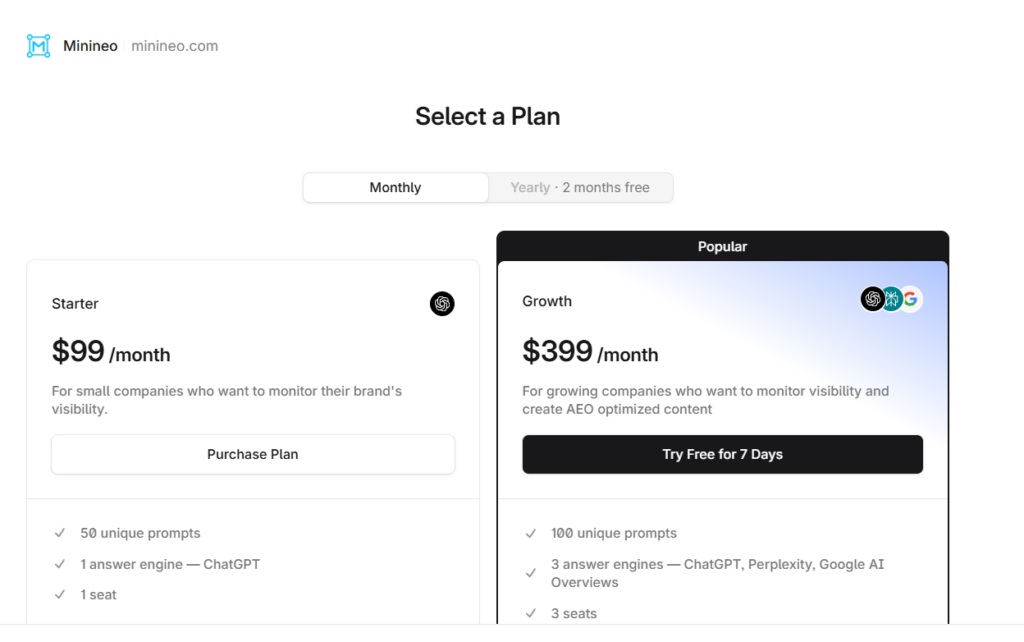
Profound does publish entry-level pricing, worth noting since a lot of write-ups on this space assume it doesn’t. Per Profound’s own pricing page, Starter is $99/month and Growth is $399/month. Starter covers ChatGPT only, 50 tracked prompts, 1,500 responses analyzed monthly, and 1 seat. Growth expands to 3 engines (ChatGPT, Perplexity, Google AI Overviews), 100 prompts, 9,000 responses monthly, and 3 seats. Enterprise is custom, and that’s the tier most of the 700+ companies the company serves, including Target, Figma, and Walmart, are actually on.
Key Features:
- Daily prompt tracking across major AI engines, with every response stored
- “Conversation Explorer” surfacing AI search volume around your category, demand data that wasn’t visible before
- Agent-style workflows for ongoing optimization, not just monitoring
- Serves 700+ enterprises including Target, Figma, and Walmart, per the company’s own funding announcement
Best For: large brands and agencies that need daily monitoring, seat-based team access, and reporting that goes to a board, not just a marketing lead.
Pros:
- Unlike most of this list, entry pricing is public rather than demo-gated
- Deepest daily-tracking and prompt-intelligence data in this category
- Backed by serious enterprise adoption, not just marketing claims
Cons:
- Starter’s 50 prompts and single-engine (ChatGPT-only) coverage won’t tell you much about Gemini or Perplexity visibility; you need Growth or above for that
- Enterprise, the tier serious brand-scale monitoring actually needs, is still a custom quote behind a sales call
2. Ahrefs Brand Radar
If your SEO team already lives in Ahrefs, Brand Radar is the path of least resistance. It sits inside a tool you’re already paying for and already trust for keyword and backlink data.
Key Features:
- Per Ahrefs’ own Brand Radar page, “Select Platforms” is priced per platform at $199/month each, from AI Overviews, AI Mode, ChatGPT, Perplexity, and Microsoft Copilot/Gemini, so 1 platform is $199/month, 2 is $398, 3 is $597, 4 is $796, and all 5 is $995. “All Platforms” is a flat $699/month bundle for full access to Ahrefs’ 402M+ prompt database, cheaper than buying all 5 individually. Both tiers include 2,500 checks per month for custom prompts (one check equals one prompt times one LLM times one location)
- Both tiers also include bonus tracking across YouTube, TikTok, and Reddit (free while in beta), plus search demand and web visibility data
- Backed by Ahrefs’ study of AI Overview citation patterns across 75,000+ brands, one of the more credible independent data sets in this space, worth reading even if you don’t buy the tool
Best For: SEO teams that want AI visibility sitting next to their existing rank-tracking data, without switching tools.
Pros:
- No new login or vendor relationship if you’re already an Ahrefs customer
- Backed by genuinely large-scale independent research on AI citation behavior
- Free AI Visibility Checker lets you preview your brand’s AI visibility before buying anything
Cons:
- Tracking more than 3-4 platforms individually costs more than just buying the $699 All Platforms bundle, so the per-platform pricing only makes sense if you genuinely only care about 1 or 2 engines
- Built as an SEO-team add-on first, not a standalone AEO product, and the interface reflects that
3. Semrush AI Toolkit
Semrush took a more accessible approach here than Ahrefs did, and it’s the one I’d point a budget-conscious in-house marketer toward if they’re already a Semrush customer.
Key Features:
- Tracks brand mentions across AI Overviews, AI Mode, Gemini, and ChatGPT
- $99/month per domain, per Semrush’s pricing page; it covers 25 tracked prompts, with a reporting suite covering Visibility Overview, Prompt Research, Competitor Research, Brand Performance, and AI Search Site Audit, per Semrush’s own documentation
- Sits next to your existing Semrush keyword rank tracking, so you can see the overlap between Google rankings and AI citations in one place
Best For: teams that want AI visibility without a second subscription and a second login.
Pros:
- Lowest realistic all-in cost of the “SEO suite add-on” tools compared here
- Reporting suite is broad for the price point
Cons:
- No free trial on the AI Visibility Toolkit specifically
- 25 base prompts is thin. Expect to pay for add-on prompt blocks quickly if you track a competitive category
4. Peec AI
Peec is one of the two “born for this” tools (alongside Otterly) that agencies keep recommending to each other, and the reason comes down to reporting.
Key Features:
- Starter is $95/month month-to-month (drops to $80/month, saving $180/year, if billed annually), covering 50 prompts, 1 project, and a choice of 3 AI models (from ChatGPT, AI Mode, AI Overviews, Microsoft Copilot, Perplexity, and Gemini), per Peec’s official pricing page
- Pro is $245/month ($205/month annually, saving $480/year) for 150 prompts and 2 projects, and Advanced is $495/month ($420/month annually, saving $900/year) for 350 prompts, 5 projects, multi-country tracking, and Looker Studio integration; Enterprise is custom and tracks up to 11 AI models total
- Tracks AI engines with a clear separation between explicit brand mentions and actual source citations, a distinction a lot of cheaper tools blur
- Unlimited users and daily tracking included on every tier, including Starter
- Additional AI models beyond the 3 included can be added for $35/month (Starter), $85/month (Pro), or $165/month (Advanced) each, dropping to $30/$70/$140 if billed annually; a separate agency pricing track exists for tracking multiple client brands
Best For: agencies managing AI visibility reporting across multiple client accounts.
Pros:
- Unlimited seats on every tier. Cost scales with prompts, not with how many people need access
- Purpose-built agency reporting, not bolted onto an SEO suite
Cons:
- Entry tier covers only 1 project and 50 prompts, so a real multi-client rollout means moving up to Pro or Advanced quickly
- Additional AI model coverage is a paid add-on on top of the base plan
5. Otterly AI
Otterly is the cheapest real entry point into this category, and it’s the one I’d suggest to a solo marketer or a small team testing whether AI visibility tracking is worth budgeting for at all.
Key Features:
- Lite plan tracks 15 prompts across 4 AI engines, plus 50+ country tracking and 1,000 GEO URL audits, per Otterly’s official pricing page
- GEO content audit that scores individual pages against AI-readability best practices
- Unlimited workspaces and countries even on lower tiers
Best For: freelancers, solo marketers, and small teams who want a fast, low-commitment way to start tracking before scaling into something bigger.
Pros:
- Lowest published entry price in this list for a dedicated AI visibility tool, at $29/month
- Free trial available before you commit; see Otterly’s help center for current trial terms
Cons:
- No API/MCP access until the $189/month Standard tier
- Google Gemini and Google AI Mode are paid add-ons on top of the base price, not included
6. Minineo
Minineo is included here for what it does differently, not because it beats the dedicated tools above on raw AI-monitoring depth. It doesn’t, and I’d rather say that than oversell it.
Every tool above does one job: tell you where your AI visibility stands. Minineo was built around a different question we kept hearing from smaller teams and D2C brands: “okay, we’re not mentioned, now what do we actually do about it, without hiring three more tools?” So AI visibility tracking sits inside the same dashboard as the SEO audit, the content generator, and the page publisher that fix the gaps it finds.
Key Features:
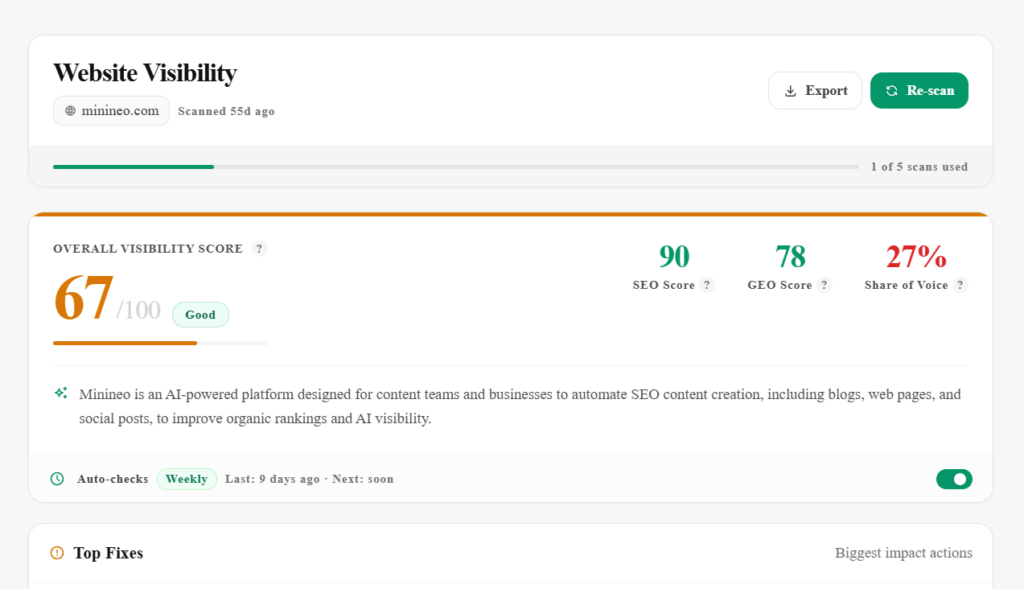
- Separate SEO score and GEO score for your site, plus an overall visibility score
- Share of Voice tracking across ChatGPT and Gemini, based on prompts generated from your own homepage
- Sentiment and mention-prominence flags: whether you’re cited early in an answer or buried at the end
- robots.txt and llms.txt checks (see our explainer on what llms.txt actually does)
- When it finds a gap, a missing page, a competitor showing up where you don’t, the content and page tools to close that gap are in the same product
Best For: SMBs and D2C brands that want visibility tracking and the ability to act on it in one place, rather than running a monitoring tool alongside a separate content stack.
Pros:
- Free tier includes AI visibility checks, not just a locked demo
- Tracking and the fix (content/page generation) live in one dashboard
Cons:
- Not built for daily multi-engine enterprise reporting the way Profound or Peec are. Minineo trades monitoring depth for breadth (tracking plus fixing)
- Currently covers ChatGPT and Gemini rather than the full six-engine spread some dedicated trackers offer
7. SE Ranking
SE Ranking bundles a baseline of GEO/AI prompt tracking directly into its regular SEO plans rather than gating it entirely behind an add-on, then sells a bigger, dedicated AI tracking tier on top for teams that need more depth.
Key Features:
- Core is $129/month: 10 projects, 1 manager seat, 2,000 tracked keywords, 100 AI/GEO prompts tracked daily, GEO research across up to 5 domains, 250k pages/month in site audits, and 25K API credits with MCP access, per SE Ranking’s own pricing page. Growth is $279/month with roughly double most limits (30 projects, 5,000 keywords, 250 prompts/day, 15 domains, 2M pages/month, 100K API credits)
- Both plans include a 14-day free trial with no credit card required; per SE Ranking’s own FAQ, the trial itself includes 20 AI prompts tracked daily and AI competitive research across up to 3 domains, so you can test GEO tracking before paying
- A separate “AI Search” add-on scales from $89/month for 200 tracked prompts up to $345/month for 1,000, covering AI Overviews, AI Mode, Perplexity, and ChatGPT at every tier, plus unlimited competitor research across those engines and a dedicated dashboard for brand mentions, citations, and sentiment
Best For: teams already using SE Ranking for rank tracking who want baseline GEO tracking bundled in, with the option to scale into deeper AI-specific tracking later.
Pros:
- GEO/AI prompt tracking is bundled into the regular Core and Growth plans, not an all-or-nothing add-on purchase
- 14-day free trial, no credit card required, and the trial itself includes real AI prompt tracking to test before you pay
Cons:
- The confirmed engine list (AI Overviews, AI Mode, Perplexity, ChatGPT) applies to the AI Search add-on; it’s not clear from SE Ranking’s page which of those the baseline 100/250 daily prompts in Core and Growth actually cover, and Gemini isn’t mentioned at all
- Stepping up from the bundled baseline to the dedicated AI Search add-on costs an extra $89 to $345/month on top of Core or Growth, depending on how many prompts you need
8. Scrunch AI
Scrunch runs a simpler two-tier structure than most of this list, Core or Enterprise, but the feature that actually makes it different from a pure tracking tool only shows up in the tier most buyers won’t start on.
Key Features:
- Core is $250/month: 125 unique prompts, 5 site audits per month, 1 brand workspace, 5 user licenses, and coverage across 4 LLMs, ChatGPT, Perplexity, Google AI Overviews, and Copilot, per Scrunch’s official pricing page
- Enterprise is custom-priced and is where Scrunch’s “Agent Experience Platform” (AXP) actually lives, an infrastructure layer between your site and AI crawlers that serves structured, compressed content without changing what human visitors see
- Enterprise also expands engine coverage to 9 LLMs (adding Claude, Gemini, Meta AI, Google AI Mode, and Grok on top of Core’s 4), plus SSO, API access, and a dedicated account team
- Agencies get a separate track: Agency Core is $500/month for 250 prompts, 3 brand workspaces, 3 pitch workspaces, and unlimited user licenses (still the same 4 LLMs as brand Core); Agency Enterprise, like the brand version, is where AXP and 9-engine coverage actually live
Best For: teams that want to benchmark AI visibility on a fixed budget first, with the option to move up to Enterprise once they need the crawler-facing AXP feature or broader engine coverage; agencies managing multiple client brands have a separate Agency Core plan at $500/month.
Pros:
- 7-day free trial on Core, so you can test before paying
- Simple two-tier structure instead of several confusing mid-tiers
Cons:
- AXP, the feature that most separates Scrunch from a pure monitoring dashboard, isn’t included in Core at $250/month; it’s Enterprise-only and priced custom
- Core caps out at 125 tracked prompts and 1 brand workspace, thin for anything beyond a single-brand pilot
9. Nightwatch
Nightwatch has a longer history as a traditional Google rank tracker, and unlike SE Ranking or Semrush, it bundles AI tracking directly into every plan rather than selling it as a separate add-on. Note the pricing is in euros, not dollars.
Key Features:
- AI tracking is included at every tier, not sold separately, per Nightwatch’s own pricing page: Starter is €99/month month-to-month (€79/month, €948/year, if billed annually) with 50 AI prompts and 1,500 AI responses monthly, Professional is €199/month (€159/month billed annually) with 150 prompts and 4,500 responses, Agency is €499/month (€399/month billed annually) with 500 prompts and 15,000 responses, and Enterprise is custom with unlimited prompts and responses
- Every tier covers the same 6 AI platforms, ChatGPT, Claude, Gemini, Perplexity, Google AI Mode, and Google AI Overview, which is separate from its traditional rank-tracking coverage across Google, YouTube, Bing, Yahoo, DuckDuckGo, and Google Maps
- Bundled with the traditional keyword rank tracking most existing customers already bought it for, plus unlimited user seats on every tier except Starter
Best For: teams already using Nightwatch for Google rank tracking who want AI visibility included rather than sold as a separate line item.
Pros:
- AI tracking is genuinely bundled, not an upsell with its own bill
- 14-day free trial with full feature access, per Nightwatch’s own pricing page
- No per-seat fees on Professional, Agency, or Enterprise, unlike some competitors that charge per seat on every tier
Cons:
- Pricing is in euros, so budget for currency conversion when comparing against the dollar-priced tools on this list
- Newer to AI tracking specifically than the purpose-built trackers on this list, since Nightwatch’s core product and reputation were built around traditional rank tracking first
Comparison
| Tool | Best For | Verified Starting Price | Engines Tracked | Free Tier / Trial |
|---|---|---|---|---|
| Profound | Enterprise / agency AEO | $99–$399/mo by tier, Enterprise custom (pricing) | 1 to 3 engines by tier | No |
| Ahrefs Brand Radar | Existing Ahrefs SEO teams | $199/mo per platform (up to $995 for 5) or $699/mo All Platforms bundle (pricing) | AI Overviews, AI Mode, ChatGPT, Perplexity, Copilot, Gemini; plus YouTube/TikTok/Reddit (beta) | No (free AI Visibility Checker preview) |
| Semrush AI Toolkit | Existing Semrush customers | $99/mo per domain, add-on (pricing) | AI Overviews, AI Mode, Gemini, ChatGPT | No |
| Peec AI | Agencies, client reporting | $95/mo month-to-month ($80/mo billed yearly), Starter, 50 prompts (pricing) | 3 models (base), more via add-on | Free trial |
| Otterly AI | Solo marketers, small teams | $29/mo, Lite, 15 prompts (pricing) | 4 (Gemini/AI Mode extra) | Free trial |
| Minineo | SMBs/D2C wanting tracking plus fixes in one tool | Free tier available (pricing) | ChatGPT, Gemini | Yes, free plan |
| SE Ranking | Teams wanting GEO tracking bundled with SEO, not sold separately | $129/mo (Core, includes 100 prompts/day); $89–$345/mo add-on for 200–1,000 prompts (pricing) | AI Overviews, AI Mode, Perplexity, ChatGPT (add-on tier) | 14-day free trial, no card |
| Scrunch AI | Benchmarking on a fixed budget, with room to scale into AXP/crawler control | $250/mo (Core, 125 prompts); AXP and 9-engine coverage require custom Enterprise pricing (pricing) | 4 (ChatGPT, Perplexity, Google AIO, Copilot) on Core; 9 on Enterprise | 7-day free trial |
| Nightwatch | Existing rank-tracker customers | €99/mo month-to-month (€79/mo billed yearly), Starter, 50 prompts (pricing) | ChatGPT, Claude, Gemini, Perplexity, Google AI Mode, Google AI Overview | 14-day free trial |
Prices verified directly against each vendor’s own pricing page in July 2026, not against third-party review summaries. These change often, so click through and confirm current numbers before you buy.
AI visibility metrics worth tracking, regardless of tool
Whichever tool you land on, don’t just watch a single “mentioned yes/no” number. The ones that actually change what you do next:
- Share of voice: the percentage of your tracked prompts where your brand gets mentioned at all, relative to competitors in the same answers.
- Citation vs. mention: being named in the text isn’t the same as being linked as a source. Only citations send you the crawler traffic and the credibility.
- Prominence: whether you’re mentioned in the first third of the answer or buried at the end. Position matters as much as presence.
- Sentiment: AI answers can mention you and still frame you as the cheaper, less-trusted option next to a competitor.
- Source overlap: which of your own pages, or third-party mentions of you, the AI engine is actually pulling from, so you know what to reinforce.
We wrote more on why this matters structurally in GEO vs SEO and on the crawler-access side of this in our hybrid engine optimization guide.
FAQs
No. They measure a different surface. SEO tools track Google rankings; AI visibility tools track whether AI engines mention and cite you in generated answers. Most brands need both; we cover the overlap and the differences in our SEO vs GEO breakdown.
Most tools run a set of tracked prompts (questions your buyers would realistically ask) through ChatGPT, Gemini, or other engines on a schedule, then check the responses for your brand name, your domain, or a link back to your site, and log whether you appeared, how you were framed, and who else showed up in the same answer.
Free checkers are fine for a first read: are you showing up at all, roughly how you compare to two or three competitors. For ongoing tracking, prompt history, and sentiment trends over time, you’ll want a paid tier that runs checks on a schedule rather than a one-off scan.
Yes, more easily than in traditional SEO in some cases. AI engines weigh clear, well-structured, specific content and third-party mentions (reviews, forum discussions, comparison pages) heavily, so a smaller brand with focused, well-cited content can out-perform a much bigger competitor with thin or vague pages.
Not entirely. Profound is a good example: Starter and Growth are genuinely public at $99 and $399 a month, but Enterprise, the tier most large brands actually land on, is still a custom quote behind a sales call. SE Ranking works the same way in reverse: the add-on price is public, but it only makes sense stacked on top of a paid Core or Growth plan you have to buy separately. Ahrefs has its own version of this: per-platform pricing at $199/month looks cheap for one engine, but track more than two or three and the flat $699/month All Platforms bundle ends up cheaper anyway, so the “starting price” isn’t necessarily what you’ll actually pay. Always ask for the fully-loaded monthly cost for your prompt volume and engine coverage before comparing “starting price” across tools.
